Multiple ICAT Assessment Guides used to implement NAMA in Mexico
Read More




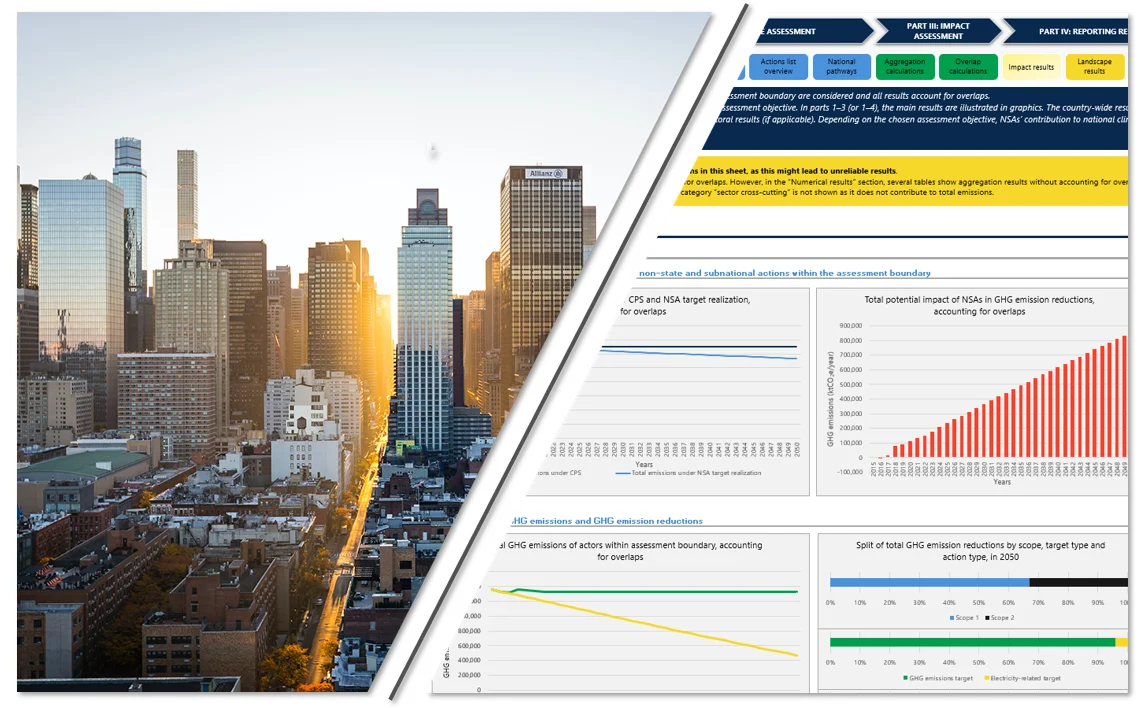
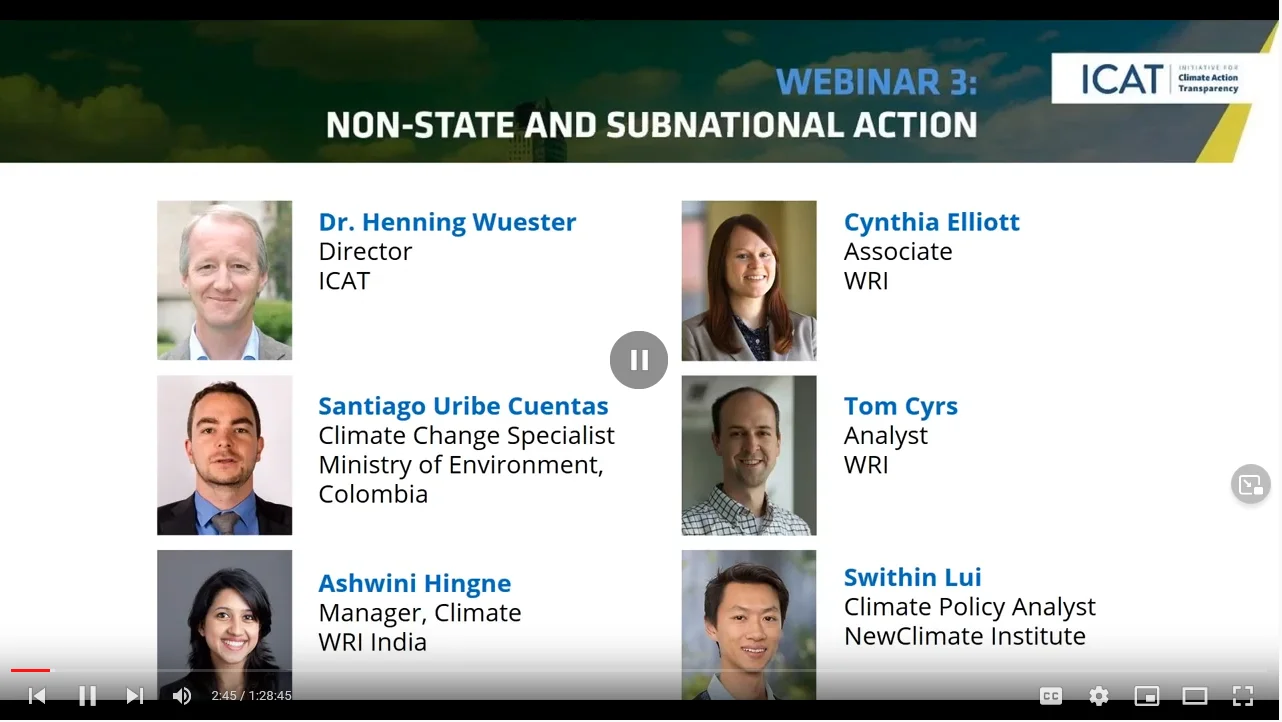
Non-state and subnational actions that contribute to climate change mitigation are becoming increasingly important and need to be explicitly considered by countries when they determine their national contributions.
The Non-State and Subnational Action Methodology provides guidance to national government agencies, research institutions and non-governmental organizations, for the integration of non-state and subnational actors’ activities.
Combine with:
To support the implementation of the Non-State and Subnational Action Guide, ICAT, with the support of NewClimate Institute and the Word Resources Institute, developed the CAAT. The CAAT allows users to:
(1) better quantify the impact of region, city, and business emissions reduction efforts;
(2) evaluate how they overlap with or complement national policies; and
(3) determine the impact of combined national and subnational efforts for integration into more holistic target-setting.
This paper discusses methodological assumptions to estimate the collective impact of mitigation commitments and targets of non-state and subnational entities. It serves as a supplement to the ICAT Non-State and Subnational Action Methodology. The paper will facilitate users in employing methods that are suitable for their specific objectives when determining the collective impact of mitigation actions taken by cities, businesses and states. It will also promote greater transparency in reporting impact assessment results.
Non-state and subnational actors are playing an increasingly important role in enhancing climate action and ambition. They can have a direct impact on national emissions trajectories, national policy implementation and the achievement of national targets. Yet, the extent to which these actions help achieve national targets, such as those in the NDCs, or go beyond them is often unknown and difficult to determine, which means they may be overlooked in projections, policy-making and target-setting at the national level. This guide strives to improve the understanding of the extent to which non-state and subnational actors are having an impact on climate mitigation efforts, thus enhancing decision-making at the national level. The methodology in the guide can address a variety of tailored objectives providing an approach that can vary depending on the aim of the user and availability of data and resources.
This section presents some key concepts and provides an overview of the specific steps involved in the assessment. It also discusses assessment principles and common challenges in quantifying and aggregating impacts of non-state and subnational actions to better prepare users for undertaking the assessment.
The section helps users define the assessment boundary in terms of sectors, actor groups, action types, GHGs, and indirect emissions included in the analysis.
This section explains how users can develop a list of non-state and subnational actions that are relevant for the assessment. It also provides criteria based on suitability of actions and likelihood of achieving targets to determine which actions should eventually be included in the assessment. The section also discusses how to characterize and understand the landscape of non-state and subnational actions in a country. Finally, it explains how to develop a list of relevant national mitigation policies depending on the assessment objectives.
This section explains how to convert the diverse range of data on targets into common metrics and potential emissions reductions, quantify overlaps and determine the impact of non-state and subnational actions, and aggregate that impact while avoiding double counting. It has a broad scope and specific calculations and assumptions will depend on users’ assessment objectives.
The section describes how to transparently report the assessment methodology and results. It also includes a list of recommended information to be included in an assessment report. The section also provides suggestions on how to apply the insights from the assessment to enhance national or sectoral policy planning and implementation.
This section lists global databases on non-state and subnational action. It also provides an overview of existing methodologies on quantifying non-state and subnational action.
Stakeholder participation can enhance the assessment process and the contribution of non-state and subnational actions. This section notes the steps in the assessment process where stakeholder participation is recommended, why it is important, and where to find additional guidance on it.
Informed by the experience of creating two country-specific datasets, this section discusses benefits and challenges of developing climate action datasets of non-state and subnational actions. It also proposes solutions for future development of datasets and outlines the process to develop such datasets.
This section lists data sources for various sectors and subsectors that users can consult if appropriate national level data is not available to estimate the potential emissions reductions from actions and policies.
Glossary, abbreviations and acronyms, references, and contributors
 Read More
 Guide
CAAT Tool
Watch
Download
Download
Download
Download
Guide
CAAT Tool
Watch
Download
Download
Download
Download